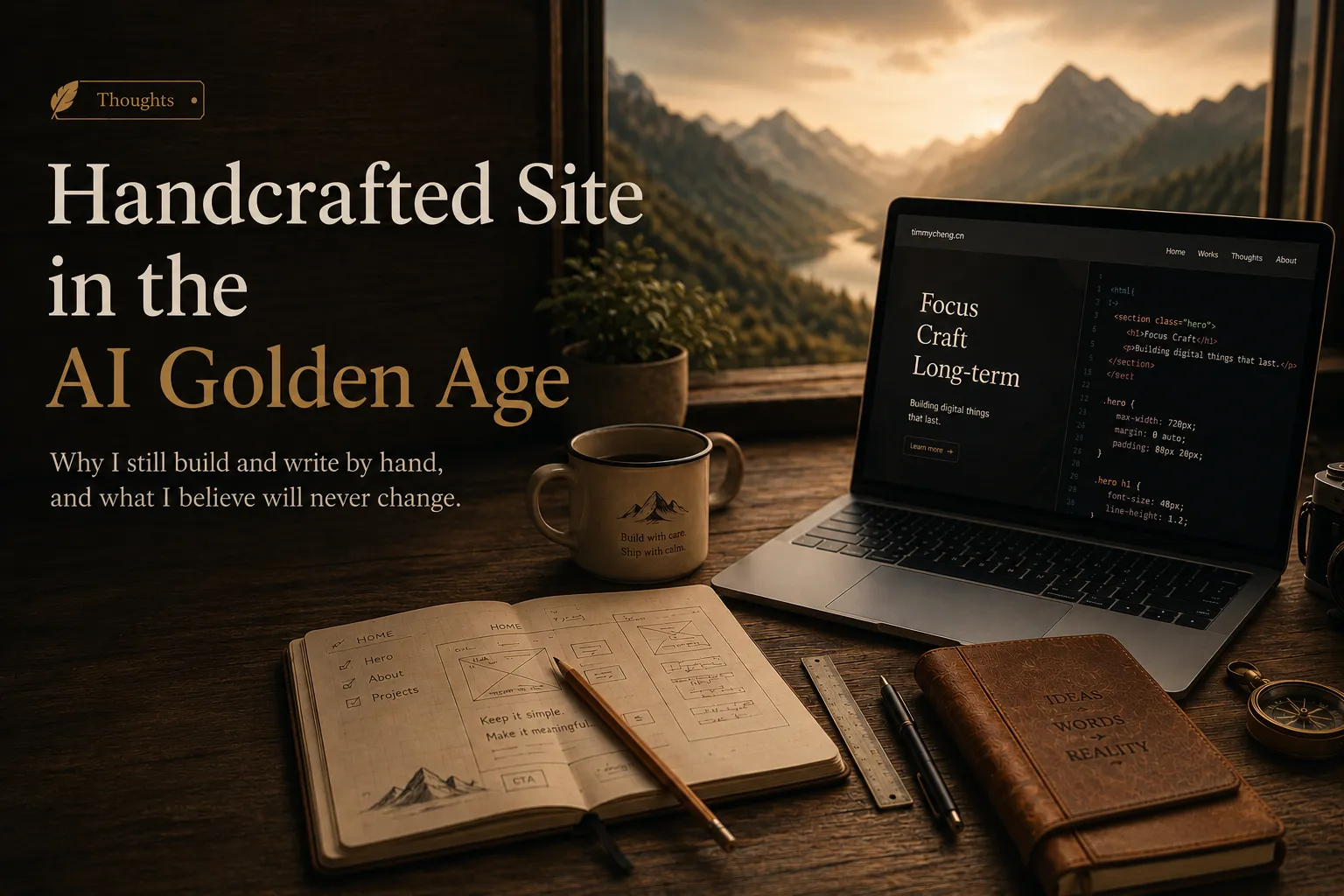
A “personal website” is an old-fashioned thing. It’s like a handwritten letter, a family photo album, or a wooden sign in your own yard that says “this is me.” In an era when all content lives inside platform feeds, owning your own domain, your own pages, your own typography looks positively outdated.
And yet I pulled it off — using the least old-fashioned tool this age has to offer.
A History of Giving Up
Confession first: this is not my first attempt at a website. To be precise, I’ve built many sites, and abandoned just as many.
It started with Hexo. I spent an entire evening picking themes, switching from NexT to NEXT and back again, and the moment hexo deploy went through, the sense of achievement was overwhelming — after which the repo sat there with two hello world posts, and there was never anything more.
Then came WordPress. Buy a domain, find a host, install plugins, fiddle with widgets, and assemble a decent-looking homepage. Write actual posts? I’d open the editor, watch the cursor blink for half an hour, and close the tab.
Later still, I genuinely went and wrote jQuery and Bootstrap. Hand-built navbars, hand-tuned grids, checking browser compatibility against Can I Use. That round taught me a lot — the site itself stayed empty.
The reason for these failures isn’t flattering, but it’s simple: I’m a lazy person, haha. Building the framework is a game with instant feedback — install a plugin, get a deployment working, and the dopamine arrives immediately; writing content, on the other hand, is a long grind with no reward. So every attempt died at exactly the same spot — the day the framework was finished was the day the project died. My head was full of shit, but the thought of hauling it all into an empty editor made my hands stop.
What the Golden Age Changed
Once the AI era arrived, building a website became infinitely simpler.
Not “websites got fancier” simpler — the friction of every single step along the pipeline got sanded away. Don’t understand Astro’s content collections? Ask, and the answer arrives with example code. Half-written component throwing an unfamiliar error? Paste it over and get an explanation plus a fix in three seconds. A TOC sidebar for articles, a reading progress bar, a giscus comment section — features that each used to be worth a whole evening of tinkering are now finished inside a conversation.
And so I found, to my surprise, that this time I actually made it past the station where I always used to stop: framework done. Not just past it, either — further on: TOC, share rail, light/dark themes, even bilingual switching, and this very article, all completed casually along this newly-paved road.
A New Lease of Life for an Old Craft
Here’s the interesting part: AI didn’t turn the personal website into something new. It simply made the old craft sustainable for the first time.
A personal site used to be a project demanding constant willpower — and you can imagine the willpower reserves of a lazy person. Now the maintenance cost is crushed to nearly zero: want to change a style? One sentence away. Want a new feature? One sentence away. Even that pile of shit in my head gets coaxed out, tidied up, and shaped into articles through conversations with AI.
Writing this, I realize the truest description of this site is: an old-fashioned shell, a golden-age heart. On the surface it’s no different from a personal homepage twenty years ago — a domain, some articles, an about page; but what keeps it alive is a condition no previous era ever had.
All those sites that died on Hexo, WordPress, and jQuery over the years — if they’d held on until today, they’d probably all still be alive.
So if you too once finished a framework and abandoned the repo for years, give it another try. This time, laziness is no longer a death sentence.
Comments